
I was lucky to attend this year’s Oregon State University Extension Service Joy of Gardening Conference, two days of research-based classes on edibles, ornamentals and pollinators. It was held in Corvallis, OR on July 7 and 8. The conference was well organized and had excellent presenters. I learned a great deal about gardening that can be applied to my personal garden as well as Jackson County Master Gardener Association projects, training and gardens.
In addition to attending, I volunteered to help new attendees staying in the dorms to get their room keys, building passes, and directions to registration, etc. I also wrote a process to provide guidance to participants and the planning committee, and submitted it to the planning committee for use in 2024. Volunteering gave me insights and great appreciation for how hard the Joy of Gardening planning committee works and the value they bring to the Master Gardeners of Oregon. Thank you, Oregon Master Gardener Association.
The conference was excellent and every presentation provided new information to help Master Gardeners deal with current issues. I learned lessons that will be passed back to the Joy of Gardening planning group, and can also be applied to projects here at JCMGA. There were two outstanding Keynote speakers:
Tom Kaye on Coping with Climate was informative, had a good sense of humor and summarized recent research on how plants respond to changing climate. We hope he accepts our invitation to present at the 2024 Winter Dreams/Summer Gardens (WD/SG).
Dr. Melathopoulos is affectionately called “the Bee Guy”. He spoke at last year’s WD/SG and is scheduled again this fall. We hope he will update us on the fabulous Citizen Science efforts of Josephine County Master Gardeners, especially their findings about rare bees. Josephine County Master Gardeners will continue collecting data on rare bees in spite of their county commissioners’ defunding decisions. OSU is helping. This is great news.
The Joy of Gardening Conference is also a place to connect with groups to make a difference. I took a class on “Citizen Science”, an approach in which volunteers help conduct scientific research. Master Gardeners may be able to earn volunteer hours and provide a valuable service as they gather data, and it doesn’t take much effort! Please contact Grace Florjancic with any questions.
Grace and I participated in a round table discussion where we learned that most chapters are looking for ways to increase participation, retention and expand volunteers and membership. Grace and I discussed our efforts with creating Friends of the Gardens. The round table was an opportunity for different chapters to compare their issues and problem-solve. I think it should be included every year.
 I was so thrilled to see how well JCMGA is doing as a chapter. We had the greatest number of people mentioned for awards. Lynn Kunstman was awarded the Master Gardener of the Year at the state level. She so deserves this recognition. Thank you, Lynn, and congratulations. You go, girl!
OMGA raises scholarship money, via a raffle, to help people attend the Joy of Gardening Conference. This year, their Send a Friend project provided five people across Oregon the opportunity to attend. Next year, JCMGA could look into a similar fundraising effort. Perhaps it could be a reward for one of our Friends of the Garden or an outstanding student in the 2024 class.
In closing, I would like to mention another lovely activity at this year’s Joy of Gardening. Attendees visited the Polk County Inspirational Garden. We were met upon entering the garden by a Master Gardener and given refreshments, learned some history and took an informative stroll through this reclaimed area. I will let you learn about this beautiful space, its creation and development on your own virtual visit.
The Inspirational Garden has an acronym with an interesting history. FIG stands for Friends In the Garden. This beautiful place is managed and maintained by the Master Gardeners of Polk County and Friends, who are all volunteers. Brooke, the interim State MG, helped get the friends part of this in place as it was known that Master Gardeners alone could not do this on their own. Thank you to Brooke for helping to make that happen. This is a good example for us all. Many chapters have a claim to fame. It would be nice if these outstanding works were shared with OMGA and OMGA could advertise to all what Master Gardeners are doing throughout the state.
Attending the OMGA Joy of Gardening Conference was inspirational and provided me with many learnings to pass on to others. I encourage everyone to attend when they can.


 There’s a weekend every June when the lavender farms from all over the Rogue Valley are open to the public for the Lavender Festival Trail. Visitors can choose to visit them all or select a few favorites, and immerse themselves in the heavenly aroma of French and English lavender in full bloom.
 replacement (he has been working in the garden for over 15 years), so if any of you want to be a Co-GEM (Garden Education Mentor) with Margaret or just a lavender helper, come out on Wednesdays from 9-12. Contact Marcie Katz for information about the Lavender Garden at marciek10@gmail.com
 You’ve heard me talk about the GEMS before. Formally known as the Garden Education Mentors, they are the garden caretakers and custodians of the beautiful Demonstration Gardens on the Extension grounds.

 in ancient Armenia. Alexander the Great is said to have introduced them to Greece. They were later introduced to the Romans. It’s believed apricot trees were introduced to the New World by Spanish missionaries in California in the early 18th century. Early French explorers brought them to the eastern US in the 1700’s.
 In September of 2021, the irrigation wells on the OSU Southern Oregon Research and Education Center campus in Central Point ran dry. Watering of all campus demonstration gardens stopped, and plants in the native plant nursery began to die. Through a massive emergency effort, the nursery stock was either donated to local restoration projects or taken to member homes to be maintained until we could install a watering system.
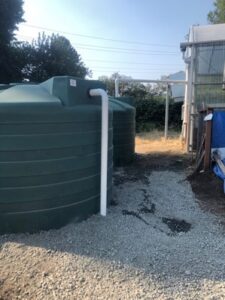 approval to install the rain catchment system as an emergency irrigation backup for our well. Fundraising began for the $15,000 system with a Go Fund Me campaign in February of 2022. A total of $10,367 was raised, with the remaining funds being acquired through plant sales from the native plant nursery, and a generous grant from
  rainwater to maintain the native plants in the nursery on campus in the event of another well failure. Additionally, the system will serve as a demonstration teaching tool for Master Gardeners, Small Farms, Land Stewards, 4-H programs, and any community association that would like to bring members onto campus to see what a large capacity capture system looks like. An interpretive sign was installed in early July of 2023, and we look forward to the public being able to learn about rainwater catchment on the SOREC campus.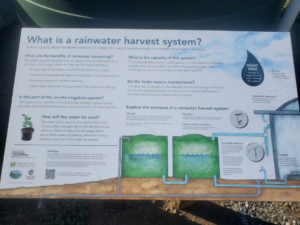
 Oregon State University Extension
